
Návštěvnost naší encyklopedie dnes trhá všechny historické rekordy !!
Návštěvnost dne 8. března 2026 byla — 612 557 unikátních návštěvníků !
Návštěvnost dne 9. března 2026 byla — 590 729 unikátních návštěvníků !
Návštěvnost dne 10. března 2026 byla — 657 697 unikátních návštěvníků !
Návštěvnost dne 8. března 2026 byla — 612 557 unikátních návštěvníků !
Návštěvnost dne 9. března 2026 byla — 590 729 unikátních návštěvníků !
Návštěvnost dne 10. března 2026 byla — 657 697 unikátních návštěvníků !
Soubor:Bulgaro-macedonian-dialect-continuum.png
Z Multimediaexpo.cz
(Rozdíly mezi verzemi)
(Fotografie +) |
(++) |
||
| Řádka 1: | Řádka 1: | ||
| - | + | Mapa + Description: | |
| + | * English: The map shows the areas where dialects of the Bulgaro-Macedonian dialect continuum are spoken: | ||
| + | ** {{Barva|#1E90FF|███}} by a plurality of native speakers | ||
| + | ** {{Barva|#87CEEB|███}} by a minority. | ||
| + | * Bulgarian and Macedonian, which together comprise the Eastern group of Southern Slavic, share a number of characteristics that set them apart from all other Slavic languages - such as the lack of cases, the post-fix article, lack of infinitive, formation of comparative forms of adjectives with the prefix po-, and the existence of preizkazno naklonenie (преизказно наклонение), a verb tense used to convey information about events which the speaker didn't witness. | ||
| + | * On a local level there is no sharp boundary between Bulgarian and Macedonian dialects and the question whether Bulgarian and Macedonian are distinct languages or dialects of a single language cannot be resolved on a purely linguistic basis (see e.g. Chambers and Trudgill, Dialectology, Cambridge University Press (1998) or David Crystal. The Cambridge Encyclopedia of Language, 2nd ed. (2010)). | ||
| + | * Date: 28 October 2011, 21:17 | ||
| + | * Source: 2001-2011 census data, except Greece and Turkey | ||
| + | * Author: User:Fobos92 | ||
| + | |||
| + | {{Cc-by-sa-4.0}} | ||
| + | [[Kategorie:Mapy světa PNG]] | ||
Aktuální verze z 6. 10. 2025, 09:43
Mapa + Description:
- English: The map shows the areas where dialects of the Bulgaro-Macedonian dialect continuum are spoken:
- ███ by a plurality of native speakers
- ███ by a minority.
- Bulgarian and Macedonian, which together comprise the Eastern group of Southern Slavic, share a number of characteristics that set them apart from all other Slavic languages - such as the lack of cases, the post-fix article, lack of infinitive, formation of comparative forms of adjectives with the prefix po-, and the existence of preizkazno naklonenie (преизказно наклонение), a verb tense used to convey information about events which the speaker didn't witness.
- On a local level there is no sharp boundary between Bulgarian and Macedonian dialects and the question whether Bulgarian and Macedonian are distinct languages or dialects of a single language cannot be resolved on a purely linguistic basis (see e.g. Chambers and Trudgill, Dialectology, Cambridge University Press (1998) or David Crystal. The Cambridge Encyclopedia of Language, 2nd ed. (2010)).
- Date: 28 October 2011, 21:17
- Source: 2001-2011 census data, except Greece and Turkey
- Author: User:Fobos92
+ pochází z Wikimedia Commons, kde má status – This file is licensed under the Creative Commons Attribution-Share Alike 4.0 International license. (CC BY-SA 4.0)
Historie souboru
Kliknutím na datum a čas se zobrazí tehdejší verze souboru.
| Datum a čas | Náhled | Rozměry | Uživatel | Komentář | |
|---|---|---|---|---|---|
| současná | 6. 10. 2025, 09:29 | 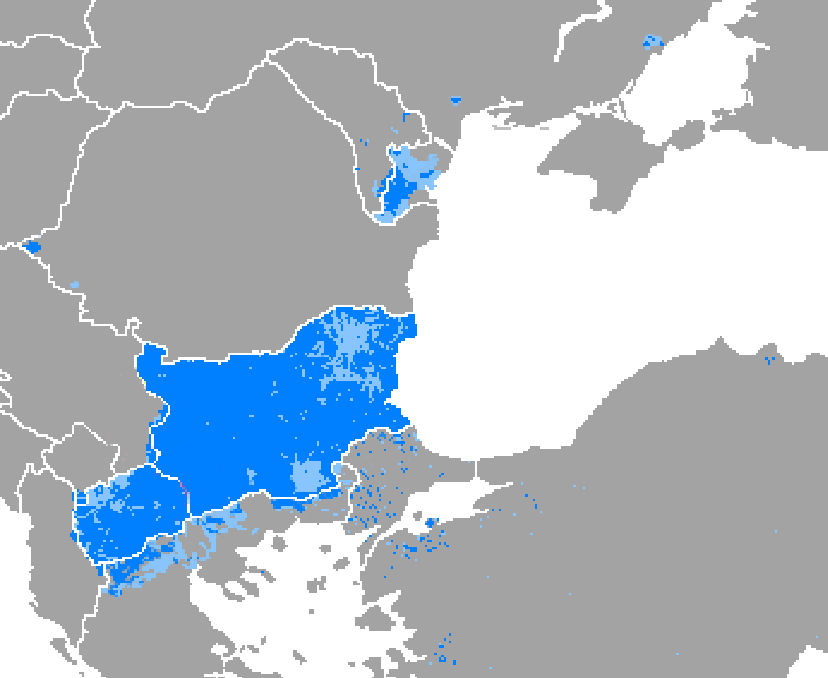 | 828×678 (18 kB) | Sysop (diskuse | příspěvky) | (Fotografie + ) |
- Editovat tento soubor v externím programu (Více informací najdete v nápovědě pro nastavení.)
Odkazy na soubor
Na soubor odkazuje tato stránka:


